

Science
Our Mission
Our science department is committed to nurturing inquisitive and analytical thinkers who are curious about the world around them. Through hands-on investigation, critical questioning, and evidence-based reasoning, students engage deeply in the process of scientific inquiry. We encourage innovation with purpose, empowering learners to design solutions, explore emerging ideas, and think creatively while remaining grounded in scientific principles. By connecting classroom learning to real-world challenges, our program helps students apply knowledge meaningfully, develop problem-solving skills, and build a strong foundation for lifelong learning, responsible citizenship, and future scientific pursuits.
Why Science matters
-
To cultivate students’ passion for Science by nurturing curiosity and interest in their environment.
-
To develop strong scientific inquiry skills, including critical thinking, analysis, and evidence-based reasoning.
-
To foster positive habits of mind and attitudes essential for scientific exploration and lifelong learning.
-
To engage students in hands-on investigations that promote active inquiry and problem-solving.
-
To encourage purposeful innovation and creative thinking grounded in scientific principles.
-
To help students understand themselves and the world around them through meaningful scientific learning.
-
To connect scientific concepts to real-world challenges and practical applications.
-
To prepare students for responsible citizenship and future pathways in science and related fields.
Our Key Programmes
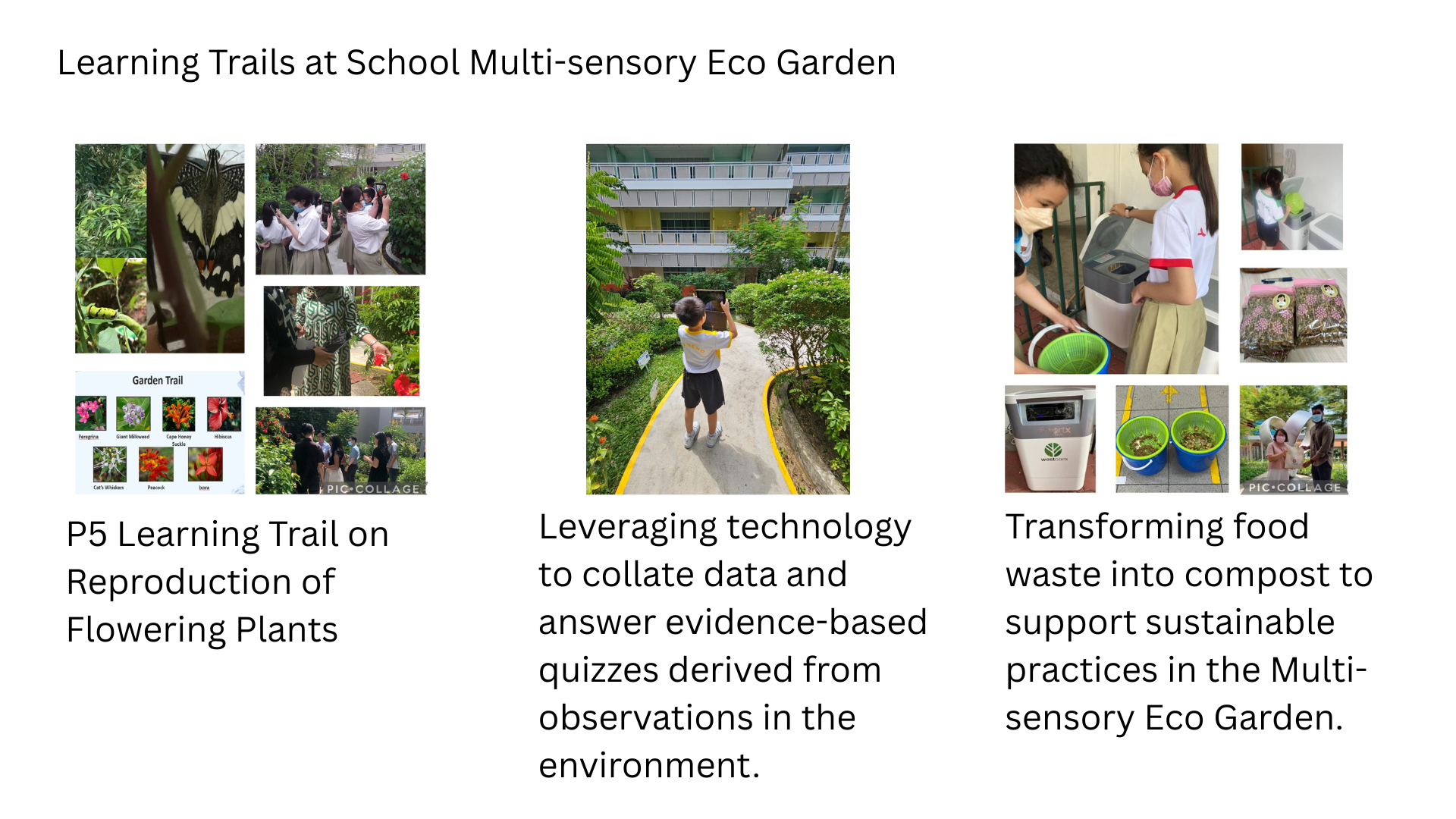
A) Environment as the third teacher – Learning Trails at the Multi-sensory Eco Garden
Revamped in 2019, our multisensory garden serves as an authentic outdoor
learning space that supports the Science department’s mission of nurturing
inquisitive and analytical thinkers. Designed like botanical gardens around
the world, it features a range of mini gardens—including the butterfly,
perfume, fruit, vegetable, herbs and spices, and rhapsody gardens—that
stimulate students’ senses and curiosity. Through purposeful scientific
inquiry in this rich environment, students engage with biodiversity, deepen
their understanding of themselves and the natural world, and apply classroom
learning to real-world contexts. From P3 to P6, students participate in
at least one learning trail annually, exploring key concepts such as classification
and life cycles (P3), plant systems (P4), plant reproduction (P5), and
environmental factors (P6).
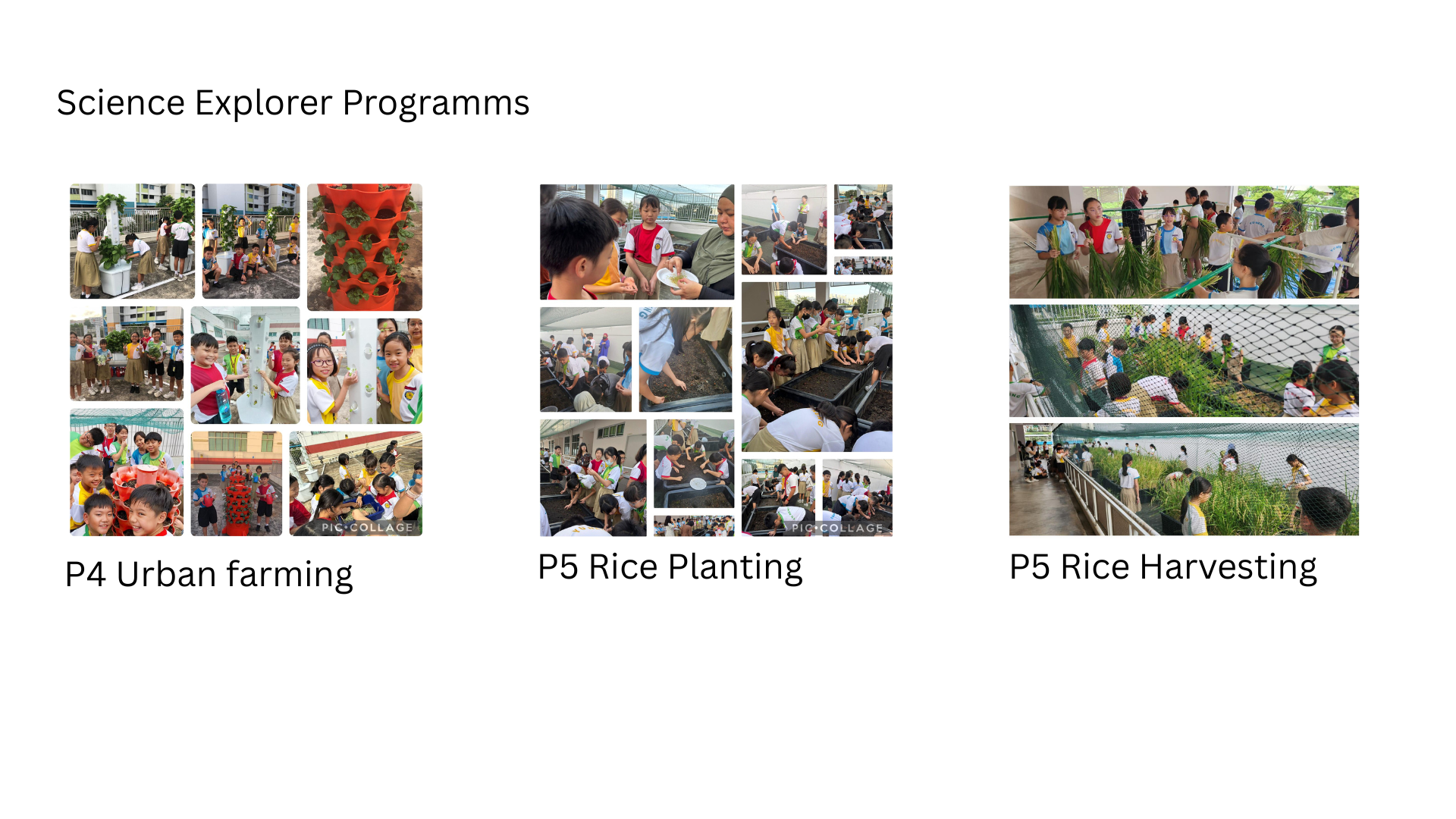
B) Science Explorer Programme
The Science enrichment programme is designed to cultivate students’ passion
for Science by nurturing curiosity, inquiry, and innovation beyond the
classroom. Through engaging science demonstrations, collaborative group
work, and hands-on experiments, students develop essential inquiry skills,
positive scientific habits of mind, and critical thinking competencies
while applying scientific concepts to real-world challenges. These meaningful
learning experiences also support the development of 21st-century competencies
(E21CC), preparing students for responsible citizenship and lifelong learning.
At each level, students engage in age-appropriate investigations:
P3 students design animal habitats
P4 students conduct investigative experiments on urban farming techniques
P5 students explore rice cultivation through scientific experimentation
P6 students create science-inspired toys
Students also share their learning during Science Thinkers Day, fostering communication, collaboration, and reflective thinking.
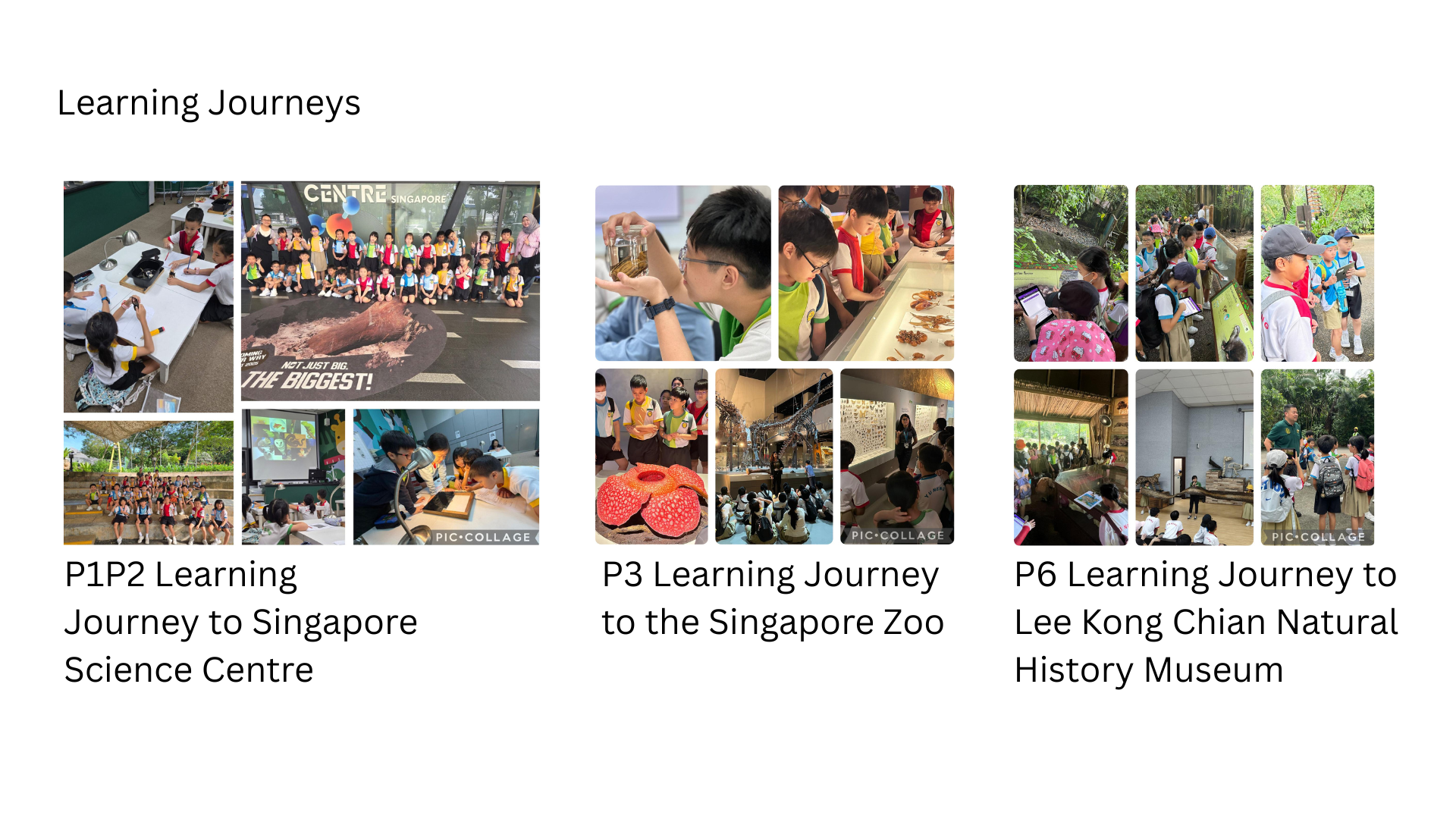
C) Learning Journeys
Scientific learning in our department is designed to nurture curiosity,
inquiry, and real-world application beyond the classroom. These experiences
strengthen inquiry skills, cultivate positive scientific habits of mind,
and help students better understand themselves and the world around them.
Learning journeys beyond the school provide meaningful contexts for students
to apply scientific concepts and connect classroom learning to real-life
experiences.
P1 and P2 – Singapore Science Centre
Primary 1 and Primary 2 students participate in interactive workshops
at the Singapore Science Centre, deepening their understanding of garden
habitats (P1) and the world of insects (P2). These hands-on experiences
reinforce STELLAR concepts, spark curiosity, and foster a passion for Science
and the environment.
Primary 3 – Singapore Zoo
Primary 3 students explore the interdependent relationships between humans
and nature through a Body Covering Talk at the Wildlife Learning Centre
and an ICT-enhanced learning trail. These activities support inquiry into
animal habitats and classification while developing analytical thinking.
Primary 6 – Lee Kong Chian Natural History Museum
Primary 6 students visit the Lee Kong Chian Natural History Museum to
explore global biodiversity and animal adaptations. Through hands-on workshops
with specimens, students deepen their understanding of survival adaptations,
applying scientific reasoning and inquiry skills in an authentic context.
Activities
The Yu Neng Difference
Our Science Department programme is distinctive in its strong integration of authentic learning environments, inquiry-based pedagogy, and real-world application. Learning extends beyond the classroom into purposeful spaces such as the Multi-Sensory Eco Garden and thoughtfully curated learning journeys, where students engage directly with nature and scientific phenomena.
What sets Yu Neng Primary School apart is our emphasis on student-designed and student-driven projects. Students are actively involved in the designing of animal enclosures based on the collation of data during their learning journey to the Singapore Zoo, applying scientific knowledge to meet the needs of living things while developing empathy, responsibility, and systems thinking. In addition, students participate in rice planting cultivation and urban farming programmes, where learning begins from seed selection and germination, rather than relying on external vendors. This end-to-end experience allows students to observe life cycles, understand sustainability, and appreciate food sources through authentic scientific practices.
The programme also adopts a blended learning approach, strategically leveraging technology alongside hands-on experiences. Digital tools are used to support observation, data collection, research, and reflection, while practical investigations enable students to test ideas, make predictions, and draw evidence-based conclusions. This combination empowers students to take ownership of their learning and pursue investigations driven by their curiosity about their surroundings and the environment.
Through structured enrichment programmes, inquiry-based investigations, and cross-level learning trails, students develop curiosity, critical thinking skills, and positive scientific habits of mind. By consistently connecting scientific concepts to real-life contexts and environmental stewardship, the programme nurtures passionate, analytical learners who innovate with purpose and grow as informed, responsible citizens committed to sustainable living.